Saturday, 24 April 2010

The Reign of Rykiel: French Designer and Icon's Interview

Most have only seen that shade of startling red and particular coif on the crowned heads of Europe; Queen Elizabeth I had that shade of rouge in her frizzy bob and it was all the rage circa 1558. There are other portraits of various European royals with similar gravity defying cuts too in erstwhile eras. Surely no less than royalty, "The Queen of knits" Sonia Rykiel, is the uncrowned doyenne of Parisian fashion. She speaks exclusively to P.Ramakrishnan about her Asian visits and influence, prior to the unveiling of her latest collection.

Images courtesy of The Swank.


In an age that extols thinness, there is no greater model for the sartorial styling of Sonia Rykiel than the designer herself. With a bone structure that models dream of and photographers lust after, a slim silhouette that drapes her signature knits in ways that Twiggy couldn't pull off with as much panache, her dreamy eyes and insouciant smile all make for intriguing images.

To label her merely a 'designer' is a near insult; singer, writer, artist, inspiration, icon, novelist, social commentator, thinker, mother, actress and so much more, conversation with the legend is typically French-cryptic, loaded with double entendre (and not in a vulgar way for she's never done anything vulgar in her 77 years). In saying little, she says much.

A profession that constantly demands new samples of creative fecundity every season, Rykiel has been in the business for nearly 40 years. To be precise, it is 38 years since she sent back a sweater (eight times) during her second trimester in 1968 when she couldn't find chic, comfortable maternity wear. She simply says, "I became a designer by accident, it was not planned."

Her husband owned a shop and she created a few items, mostly for herself, but when ELLE magazine put one of her knit ensembles on its cover, there was no going back to her original plan, which was "to get married and have 10 children."

Through an unprecedented career that still finds renewed and constant interest, Rykiel's knitwear is a signature look that she can't escape. If the showing at her namesake store in Central was anything to go by, the ones doling out their black Amexes were happy to embrace her latest inspired collection of shirt-dresses, minis, boat neck sweaters - all in short and loose silhouettes. As Suzy Menkes said of Rykeil: "She has a way of embracing the new without changing her merry romps on the runway, where the models exude an ooh-la-la cheerfulness."


The surprise for those who sat in the haloed front row of her Spring/Summer 2007 show in Paris was the fact the models were smiling their way down the catwalk in colourful ensembles. The colour wasn't the innovation, but getting the feline models to Cheshire grin their way through to the end of the catwalk was, as instructed by Rykeil's team as she presented a joyful collection unlike her counterparts and their grim and theatrical runway shows.

The novel idea of happy models culminated with the designer and her daughter Nathalie coming down the runway laughing, skipping and nearly dancing their way to the end. It's one of many innovations that Rykeil has placed on the catwalk. For example, she was one of the first few to put words across the front of her sweaters, with unequivocal statements like "Je deteste le cinema" ("I hate the movies" - a proclamation that came soon after Robert Altman did a caricature of her in his film Pret-a-Porter).

Not satisfied with writing a few letters on tops and behind jerseys, she penned novellas like "Les Levres Rouges" (Red Lips) and "Je La Voudrais Nus"(I would Like Her To Be Naked), and a book of fairy tales Tatania, Acacia among other books and articles. The lover of words famously said in the international Herald Tribune, "I feel more like a novelist than a fashion designer. Someone who writes a new chapter each season, including everything I see around me."

So who is the woman wearing a long sweater with the words "I Love Black" across her breasts?

"Any woman who wants to wear fashionable clothes and can manage to wear them, as long as she is able to to play with it," she responds. "These clothes are made for a woman of no specific age, any woman can wear them as long as she knows herself and her body well. It is also a fact that our customers are becoming younger, as the collections are improving a lot. But the clothes can fit any woman, a woman with a body like mine, or like Nathalie's."

Describing the kind of women she wants to sport her emblematic creations, Rykeil says, "She is not defined. She is mysterious, intelligent, attentive, and she likes to play. She is also involved in today's world and issues, politics and all the ecological problems."


But do the warm, wool peasant tops with matching voluminous skirts in baby pink fit the climate, political or environmental, of our city? "We already changed some fabrics and colours for the climate. The wool is fresher, and there is a lot of cotton, and light fabric. The clothes are very easy to wear," she assures. "It's very important to me that I know my client, the worldly woman who dons my clothes."

For someone whose work influences international fashionistas, the French icon has never even dreamed of moving to New York, London, Milan, Tokyo or any of the capital cities that she's wildly popular in.

In her monarchical splendour, she once said, "You can create fashion everywhere in the world, but the place where you are crowned is Paris. It's where you are the queen."

Published in Kee magazine. 

Friday, 23 April 2010

Daring De: Indian author Shobhaa De in Hong Kong

She juggles home, husband and six children, three weekly columns and a weekly talk show on TV, churns out a bestseller each year and is more often than not hopscotching around the globe promoting, speaking and shopping! She's a woman undeniably in control. P.Ramakrishnan had an exclusive conversation with Shobhaa De, superwoman... in a nine-yard sari. 

All images by Ayesha Broacha.


Apparently the spotlight on Indian authors wasn't just a transient fad that escalated when The God of Small Things was deemed Booker Prize worthy in 1999, followed by Jhumpa Lahiri's turn to collect the Pulitzer for The Interpreter of Maladies the year after. There's so much hullabaloo for the penmen and women churning out prose and poetry out of post-colonial India.

Shove all that hype under the Persian carpet with a stiletto 'cause one woman outsells all the laureates put together; Ms Shobhaa De.

De,56, easily India's most recognisable and glamourous columnists, is as much a newsmaker as she is, in her own words, "a chronicler of our times." Not too long ago, India Today, after years of scathing reviews and unflattering portraits, deemed her one of the 50 Most Influential People in a nation of one billion. Tongue in chic, she raises her perfect eyebrows when a complimentary review was published in the weekly, days after her latest (her 14th) book hit the stands, "I must be doing something wrong."

Thoroughly amused, if not bemused, by the acerbic reviews, she remains firmly unapologetic of her work, her words, and herself. Her latest book, Spouse, The Truth about Marriage sold out its first print in 48 hours of release in New Delhi and the second edition recently reached our smog-filled shores. "Someone collected the worst reviews published ever and I think I had the most - around 315 of them from Asia alone," laughs De. "But it didn't stop me. I write because it keeps me sane, because I want to write, I need to write. I write for me, not anyone else."

The media at large slapped her with a label; the "Jackie Collins of Mumbai" - words that make her flinch even a decade after the article appeared in print. She reveals, "I've never met Jackie Collins but the comparison irritates me because I find it so completely absurd and irrelevant. It was just a lazy description by an American correspondent writing my profile in TIME magazine to make me accessible to an international readership because at the time, my first book was out and instead of just saying this person from India has written this book, he just thought it would be easier to say she's the Jackie Collins of Asia. It was the correspondent being cute and it's an albatross around my neck."

Her neck is currently swathed in a shimmering, sequined scarf and she sits on a table at a coffee shop, surrounded by samples from her shopping spree. Chairs brought in for the interview are regally ignored while a photographer clicks away for a local paper. She strikes confident poses - remnants from an early tryst with a short-lived, self-aborted modeling career. If her sharp profile is an asset, her sharper mind is a fusillade, carefully hidden under coiffed auburn curls.

Bollywood would have been the next inevitable step for this top model in Mumbai in the 1970's, but instead of appearing onscreen - despite offers from Oscar-winning auteur Satyajit Ray - she became the editor of the now-iconic Indian film rag, Stardust.

Yes, as cheesy as it sounds, it was indeed a journal of what the fine feathered folks in the Indian celebrity circuit were up to. Fan-zines litter the Indian market but she chose to wipe the halo away from the screen demi-Gods (let's not forget India is a country that erects temples for their favourite actors) and wrote defiant editorials - a trend hitherto unchanged.

She found fame early but found the famous, boring, "Some movie stars are big babies but that's their problem. I have my job, they can do their's," she waves her diamond festooned hand about, shooting away imaginary flies, "I think Indian celebrities [not unlike Hollywood!] are too accustomed to puff pieces and a level of sycophancy that I find sickening. There are people who are constantly feeding that ego. I couldn't do that."

She does refrain from commenting on newcomers that hoard Bollywood, the Indian film capital. No potshots at the upcoming youngsters or star-children who she feels need time to grow into their boots. Perhaps it's that maternal instinct kicking in, after all she's a mother of six aged between 16-32!

She does however, bring down the titans of Asia.

India's most popular actor Shahrukh Khan reacted very badly to a recent column penned by De. Brought to court to speak out against the Indian mafia, he turned into a hostile witness and retracted his statements made to the police. De called him a coward point blank.

The most powerful man and Bollywood icon a coward?

The PR machinery spun out of control. The King of Bollywood, whose Pepsi posters are visible in every nook and cranny in Mumbai, vehemently spoke out against her, "I could have got pissed off when I read Shobhaa De's article in which she called me unmanly.I told her I was disappointed in her. And I never do that for articles. I could have got really angry. There's a saying, let the dogs bark, the elephant's will go on. When you don't know the facts, you don't open your mouth, because the facts can scare the pants off you. And I told Shobhaa De so. She doesn't know what she's talking about."

Oh but she does.

Despite insisting there is no plan to keep herself in the news, Ms De has done nothing to hop out of it either.

"I don't live my life to outrage India. I'm not there to shock anybody. I say what I
believe is the right thing to say, to state if it ends up breaking the rules, then the rules get broken but it's not by design. It is not a strategy."


Then why say the biggest star in India has "no balls"?

"I never said that. I don't use that kind of language,"she says curtly. "I may have called Shahrukh a coward along with the other stars who went back on their word. But it wasn't me alone that said it. People respond very strongly to whatever I say. I'm flattered that seem only to react to what I say and ignore everything else."

Despite having left film journalism, being married to wealthy businessman Dilip De, the high-profile couple attend parties where running into a star she's written about might make the meeting awkward, I presume.

I stand corrected.

"It never gets awkward. Never ever. We're not children. Shahrukh called me up the day after the column and explained himself. I told him to speak to the press, why tell me?"

On actor Hrithik Roshan's wedding day, the national papers arrived at the doorstep of both his parents and his to-be-in-laws homes with reports of his affair with one of his co-stars.

The poster prince for good Indian values a pre-marital adulterer? A De exclusive. Fervent denials followed the same day from both parties and De was again demonised. Threats of lawsuits (long since quashed) followed. How could she say that he was "caught cootchie-cooing" with another actress when she wasn't in the picture?

"I stand by that completely. I found out that information from a very good source and an eye-witness and and it happened on a British Airways flight and I challenge Hrithik to deny it," states De.

He did deny it.

"Oh he can deny it. All stars deny anything that they find an unacceptable part of themselves but I can challenge him any time to the veracity of what happened on that flight, and that they were having a scene and they probably still are! But that's none of my business whether they are or not, but its just that I don't like hypocrisy and I don't like pretense."

But he's the golden boy of Bollywood...

"Was. Past tense. He's not anymore baby! At the time, he was projecting himself as this family guy, totally madly in love with his new wife. He may as well be, I'm not even doubting the depth of his love but whatever happened on that flight, happened on that flight. He cannot challenge that. He'd be stupid to."

Listed, with Sonia Gandhi, as one of the most prominent personalities in India, De tries - but not too hard - to let her displeasure be known. "What astonished me about the selection was the fact that there were only four women in it, in the seventh biggest democracy in the world, when you handpick 50 and out of which only four women seem to count, one of whom happens to be a political leader by default, that to me is a little depressing."

Having polished her talons and perfected the conversational approach to her column, with splatters of 'honey', 'no baby' and other socialite catch-phrases, she's the one that notes that Sonia Gandhi was wearing Gucci shoes while being sworn in at Parliament in New Delhi.

"Will any other country on the planet have a foreigner as its leader?" she asks rhetorically.

In the husky yet clear-cut tone, her cadence picks up as she states, "I like the idea that women who find themselves on various lists for whatever reason as influence makers and as opinion makers, should do so on the strength of their own personal achievements, not because they are married to someone, not because they belong to a certain family and have things on a platter happening for them. That they should have risen to whatever position like Mayavati [a minister in India] has and shown courage, merit and should be inspirational figures in their own right which has nothing to do
with their social position and standing."

As we meander through topics, it comes to mind that there hasn't been much discussion on her novels. The work she does at her dining table at home, eight hours a day, three columns each week and a book every other year, while bringing up six kids.

"The moment I'm done with a column, I forget about it. When people come and ask me what I said at that time, on that day, I go blank. I've moved on. They haven't."

The novels well behind her, she's the woman behind one of India's most popular soaps on television too. De's repeated appearances in the social pages, in addition to her national columns, headed with glamourous photo bylines, indicate a workaholic who's moved bag and baggage to an office. On the contrary, she rarely leaves home.

"Anything that's going to take me away from my kids is unacceptable. I don't like
the idea of latch-key kids, letting themselves in, fixing themselves a snack, doing their homework in isolation, waiting for mom and dad to get back. It's something I find abhorrent," she says. "I feel very sorry for kids who do it all by themselves when their parents are out. I am a hands-on mom and I will not compromise that, no matter how lucrative and how wonderful a contract may be."

She wrote and conceived the eight-women led soap Kittie Party and its tremendous success has led to her latest venture, a political drama titled Swaarth (Self) with a cast of India's top television stars. Having shot the pilot recently, it should air soon.

There are no literary prizes to boast of, and no major awards, but when an influential political magazine gives an honorary award of sorts by listing her among billionaire businessmen, ministers, priests and legendary artists, it must be a vindication... if not a jaw-dropping surprise.

The final word, as always, belongs to Ms De.

"I think it has a lot to do with establishing a track record of credibility and over 30 years, I think I have earned that position, because what I say through my column and my books has reinforced the image of someone who speaks up when she has to. There may be times when what I'm saying is not very palatable, but I've always exercised my right to say it, say it responsibly and to say it strongly,"says Ms De, trying to fathom why her sharpest critics eulogized her after three decades of verbal vitriol.

"So you always get people who don't agree with you. Dissent is very much part of
democracy and I'm completely OK with that, but once you attain a certain level of influence, to be able to sustain it for a decade or more needs a lot of hard work. It needs a great deal of genuine commitment to what you're doing and you must be able to stand up and be counted."

Wednesday, 21 April 2010

Mass Appeal: Italian designer Massimo Calestrini's interview in Hong Kong

Italian designer Massimo Calestrini's brief sojourn to Hong Kong and rendezvous with the creme-de-la-creme was a heady mix of shock and awe. P.Ramakrishnan chats with the designer whose work is much like him; unique and inspired. Images courtesy of On Peddar.


Deep in the recesses of Nicole Kidman's wardrobe, engulfed between swathes of Chanel and a private collection of Bottega Veneta, there lie remnants of her favourite mistake; gifts from an ex-lover. No, not from him, but a certain rocker who saw a vivid, ostrich-accordion-pleated handbag, with an emblematic, twin-tailed golden gecko hanging off the side, and he thought it perfect for the Australian screen-siren.

The lover was Lenny Kravitz, and the bag was unmistakably, a Shiro.

A baby in the world of fashion, the brand and it's maker, Massimo Calestrini, went from the crawling stage to a full-throttle run, taking off while newcomers struggle to get into Vogue.

African-born, Italian designer Calestrini's collection of reversible, dual-fabric, interchangeable, twin-hued jackets, bags and accessories, are as much a reflection of the creator as they are of the diverse cultures that his pan-global travels and residence have borne him.

Born and brought up Asmara, Eritrea, Calestrini moved to Addis Ababa (Ethiopia) with his family and then Yemen, Rome and Modena. A personal history that the Lonely Planet would like to pick his brains on, Calestrini's peculiar gift of noticing beauty in everyday objects, nature and his surroundings has served him well. His clothes and accessories are a hybrid of the familiar with a novel presentation. His design emblem is in fact a Shiro, the rare dual-tailed lizard that old African tribes consider a very lucky talisman. According to legend, if you can find a two-tailed lizard, you will be lucky for the rest of your life and luck certainly has favoured this fashion freshman.

The stars in style have grabbed many of his exotic creations from his line launched just three years ego. From the lapels of jackets to the bags and belts, the embellishment on suits to entire overcoats, crocodile skin and motifs loom large in the Shiro collection. It's even peeping out of fur-lined trench coats and shoes.

"I am inspired by nature, by all that I saw in Africa," says Calestrini while seated at a popular restaurant in IFC mall.


A visual festival of his colourful, impeccably tailored collection is shown to a select few, already aware of his brand.

"I've been to Hong Kong before many times and it's such an exciting city," he says with that unmistakable Italian accent. "For me, it is such an interesting market. China and India are places that are very exciting for the fashion world. I have seen beautiful ladies in their cheongsams carry my bags in contrasting colours. And I have seen women in saris with my bags with the long, thin straps that fall down to the waist, in the same colours as their saris. It's so wonderful to see my designs within such diverse cultures."

That final expression crops up repeatedly in conversation as the aesthete finds marvel in everything from the mundane to the marketable, from the rich colour palette of Africa to the symmetry of the table setting in a restaurant. "All the cities in the world that I go to inspire me in their own way," says Calestrini, dressed in his own creations. "Africa is obviously a big part of my theme in my collection but even in Hong Kong, I see that people like clean lines, not too fussy, there's symmetry. See that row of glasses on the table - see how perfectly aligned they are? And the row of lights hanging above the bar, the rectangles are aligned so finely?"

For all the joy he finds in the simplicity that he sees, the highly embellished, often colourful and textured items that churn out of Shiro seem a bit extreme, pieces that might possibly seem incongruous when placed next to the muted shades of Hong Kong's teeming business masses.

"My clothes are for people with passion, who aren't afraid of a little colour. You know if I don't like a person, then I don't sell to them."

Stretching back,he elaborates, "There is this woman in Italy, who owns and runs one of the largest boutiques. She wanted my collection but I wouldn't give it to her. I thought she was very vulgar and had no style. You know she went crazy! But that is me. Then, there was this couple I met in Four Seasons hotel, these beautiful Indian people and they were so elegant, so I invited them to my show. Then weeks later, they wanted to have dinner with me on their 25th Anniversary, and I said, 'Why me?' Their son was in Washington, their daughter in India, and their other son in Hong Kong, but they were in Milan with me. We had such a wonderful time. Later they sent me a gift; a classic Mercedes. I was shocked. But I always believed, you do good and good things happen to you."


The response to his collection shown in Hong Kong has bordered on great, not just good. The Shiro Collection, now available exclusively via On Pedder, include clothing, bags and accessories fashioned from exotic materials such as crocodile, ostrich, python, lizard, mink and sable. The crocodile and ostrich skins are hand-treated in Africa, following traditions that maintain the natural aspect of the skins. What sets this collection apart from the cookie-cutter cluster of fashionable trinkets is that they are all unique; each piece has an individual serial number and is made by Italian artisans.

The crocodile and ostrich jackets and bags are Shiro's most famous items. The jackets are made of incredibly soft, hand-treated crocodile leather, dyed in fancy hues (fuchsia, turquoise, red, green)or simpler colours (dark brown, black). The furs include light and glamorous sable, sheared mink trimmed with crocodile and cashmere coats.

Truth be told, it takes a woman of some chutzpah to pull off the bold look. So who is the woman who can best represent the brand?

"There are many beautiful women that I would love to dress, like Cameron Diaz," says the designer. "So many. I don't have one particular celebrity muse or model, but there's going to be a well-known person, not American, of mixed origin that I think will represent my vision well."

He pauses before continuing. "You know, in fact, I do have a muse. She is an African princess. She's from a royal family, Mary Haile Selassie, the Emperor's daughter, the person that received me in Ethiopia and that made me realise that there was a lot that I could do. Years later I found out that she had helped me without me even realising it. Her intelligence, modesty and elegance have left a mark on me. I have always admired her style. She had a dark complexion and long curly hair. See this brooch?" he asks, pointing to a cluster of diamonds studded on his shirt collar. "It's a 1910 Cartier. She gave it to me as a gift. I've designed some outfits for her and when I see a model in comparison, wearing the same thing, it's nothing. Style is an attitude, it's about how you carry yourself. Some people just have it, and others can only imitate it."


As the interview draws to a close, Calestrini makes sure he is keeping himself, and those around him, in stitches. "When I was little, I used to have cheeks of crocodile for breakfast. When I was younger, you know I was bitten by a crocodile, so when I grew up, I have crocodile in all my collections. Revenge." As the words are met with bewilderment, he bursts out laughing. "No, no, I'm kidding of course but it's fun to shock the media here you know?"

Indeed.

Tuesday, 20 April 2010

Kick the Girls and Make Them Cry: Hong Kong Kick-boxing Champion Joey Lee Packs.a Punch

Boys don't hit girls but Joey Lee willingly stands up to gym-toned gorillas as they kick her hard. Well,to try and kick her as she trains for Xplosion, the international Muay Thai competition. She's been on a winning streak and if her trainer's words are anything to go by, she's well on her way to becoming a World Champion. P.Ramakrishnan meets this "tough little girl" who kicks ass. Literally. Images by William Furniss.


With her hair perpetually in a ponytail, and with an easy smile and general effervescence, Joey Lee's the kind of girl who would win Miss Congeniality at any event. But she's not heading to any competition with an evening gown and bikini round. Her competition may have voyeuristic masses of screaming men, but her stage is a square-shaped battle ground and bruises, blood and bone-crunching, though not expected, are still anticipated by the wolverine crowds that congregate to watch this sport.

Traditional Muay Thai's history is distilled from Thailand, where, historically, it was a martial art used only by men in the military. Known as "The Science of Eight Limbs", hands, shins, elbows and knees are all used extensively. A Muay Thai competitor has the ability to execute strikes using eight points of contact. If late night forays into Cable TV's numbing pleasures have gotten to you, you might have witnessed the versatile, brutal martial art on 3:00am shows, and been riveted for its heated, quick and intense exercises of pain and submission.

Women were not allowed to take part in this often bloodless but bruisey sport until quiet recently. It's definitely an acquired taste and as Michelle Moldowan, Lee's childhood friend, points out, Lee wasn't born into it.

"When I knew her back in Canada, she was a very sporty, competitive person but she certainly wasn't kicking people around at an early age. I knew her from basketball and she was very determined, and in fact I remember not liking her much when I first met her!" She smiles, gives Joey a look and continues with brutal honesty, "She is just very focused on what she does, and she does it well. You have to admire
that."

While many train since tender ages, Lee has only been doing this for the past six years and is already ranked among the best in the field. With gender no bar, she has sparred with guys and gals with equal ease.

"The biggest challenge doesn't really, come from the physical aspect of this sport," she says. "As a female, its really, really hard to find a good training partner. For a competition you have to spar quite a bit and when you have, pound for pound a sparring partner, you have to find someone who's on the same level as you and someone who's the same weight. So experience and weight wise, it's really difficult to find women to train with. So you end up sparring with guys quite a bit, guys who are either heavier than you, who don't go very hard to go down to your weight. Or you end up with guys who are very green who go nuts and you end up getting hurt."

Watching others hem and heave in the ring as bullets of sweat drip down, this is one of the fastest ways to loose weight, tone and train at Pure Fitness, where Lee has a daytime gig as a personal trainer. Many have seen her kicking around at IFC, in her shimmering, trademark pink shorts as her legs go up to smack the training boards that her sparring partners sheathe their arms with. Sharp slaps of contact reverberate in the gym and they punctuate the Hip-Hop, Techno muzac that runs in endless cycles. How this little frame of a body can execute such sharp bursts of energy is beyond comprehension.

During a quick body check for perforated injuries and post-fight collateral damage, she appears surprisingly unscathed. "The only injuries I've had are two black eyes-both from training, not from actual fights," she says with a laugh. "I've had a hyper-extended elbow, which is also from sparring; I went to throw a cross and she went in for a hook and hit me right in the elbow. Flexibility wise, that's beyond the proper range of motion so tendons get stretched and that's not a nice feeling. Otherwise, I've had one badly bruised knuckle and swollen hands, but no major injury. I punched a girl on the skull and even with gloves on, I bust up my hands more than I hurt her head."

Indeed, everything's a life lesson in a sport where if you're still standing straight and walking out calmly, you're the winner at large. "No bleeding noses, no major bruises and all my teeth are still there. But they're all fake, but is that what you're asking me?" Oh she kids too.

Rigorous training, four to five times a week, particularly just before a fight means that Lee will drop anywhere between 10 to 11 pounds. Gearing up for her next match, her bags are neatly packed and she's representing Hong Kong (she was born here) in a world arena, while her family has its collective fingers and toes crossed, wishing her luck.

"My mom is very supportive but after seeing my first fight, yeah, she couldn't come to any more," she says reflecting on those back home, half a planet away in Canada. "No mother really wants to see her kid get beaten up, which is cool, but she's been supportive of everything I do."

As we go to print, Lee is training for her next big fight in Australia with her trainer Pierre Ingrassia, who says his "tough little girl" has it in her to be the best.

"Not just the best, but the World Champion. There's no one around that's as good as her. With the right support and training, she's the one to beat."

World you have been warned.


Also see feature 24 hours: Joey Lee

Thursday, 15 April 2010

The Last Emperor: Amitabh Bachchan: India's Greatest Actor in Hong Kong

It is difficult not to enthuse hyperbola when discussing Amitabh Bachchan. He is, indubitably, the most famous Indian alive. The brightest luminary of Indian cinema and star of 160 plus Hindi films, he also had a triple turn of back-to-back box-office smashes earlier this year. None too shabby for a sexagenarian grandfather in his fourth decade in Bollywood. P.Ramakrishnan was in conversation with... the last emperor.


He gets up from his wooden chair, struts in his khaki uniform and faces menacingly
at the stranger in front of him. With a swift kick to the front leg of his guest’s chair, he knocks his surprised visitor to the floor. In an ominous tone, Vijay Khanna (Bachchan) growls, “This is a police station - not your father’s house where you can do as you please.”
- Scene from the film, “Zanjeer”, 1973


Loops of different movie reels roll in my mind - images and dialogues familiar to billions of South-East Asians, besotted by the Bollywood icon. In a telephone interview with Amitabh Bachchan, 63, I’ve been put on hold hours after he landed in Mumbai after a trip from Los Angeles for a film shoot and premiere. I try to remain calm and professional as the rich, deep, Godly baritone gets back on line.

“I used to attend premiers of my movies across America in the late '70’s and '80’s, but have not done so recently. I’ve had to carry press clippings with me after 9/11 in case there’s trouble with immigration, but there hasn’t been. I don’t think September 11, the aftermath, affected the Indian film industry a lot. If you make a good film, it’ll run,” he says, sounding none too wary after his transatlantic flight.

Well, jet-setting around the globe is part and parcel of a movie star, perhaps the biggest star in the world considering the vast reach of Bollywood that spans the Middle-East, South-East Asia and even Russia. Subtitled DVDs that spring from Mumbai even reach Iceland, such is the mass appeal of “the Big B.”

In a realm far removed from his humble beginnings, Bachchan's own life would make quite a caper. Born to Teji and Harivanshraj (a renowned Indian poet/author) Bachchan in 1942, in the historic city of Allahabad, he was not an overnight success. Notoriously nepotistic as Bollywood is, he had no connections to the film industry and no film was ever bank rolled on his father's account. There were years of struggle that followed a clerical career in Calcutta, which he chucked in pursuit of fame and film. Known to few, seen by fewer, his early releases such as Saat Hindustani (Seven Indians, 1969) and Reshma aur Shera (Reshma and Shera, 1970) had him in minor roles.

"I have not forgotten the days of struggle but I don't romanticise about it. Everyone has periods of difficulties that make them who they are, life's ebbs and flow hits one and all and I was no exception. I can say this distinctly though, I've never forgotten the people who treated me with kindness, of whom there many," he says, brushing aside further nostalgic trips down memory lane.

In 1971, Bachchan was cast as the best friend of the lead star Rajesh Khanna in the film Anand, a supporting role where, finally, critics took note of his magnetic persona, and his emotive speech. The first ignition of fame was gaining momentum, a spark was lit.


In the film Zanjeer (Chains, 1973), passed up by the leading stars of the time, Bachchan was cast as a ferocious police inspector, fed up by the corruption that permeated all strata of society. It was the right film, at the right time that catapulted the young unknown into the orbit of legend. A star was born, after a lengthy, nine-film pregnancy.

In the decade that followed, Bachchan did roughly five films a year (they don't call it the biggest film industry in the world for nothing) with at least three blockbusters each year. While India Today labelled him "the one man industry", Jeetendra, his contemporary, commented,"As a superstar, he is No:1 to 10!"


A half-eaten apple lies on the ground. A nameless, tall man in semi-tattered clothes walks by. He sees the apple. He hesitates, looks around, pretends to walk away. Returns. Looks around again. Hesitates further. Assured no one's watching him, he swipes it from the ground and takes a bite; the first morsel of food he's tasted in two days. A look of satisfaction transforms his starved face for a moment. Unknown to him, a journalist is watching and recording every moment.

That man could be somebody, someday, she thinks to herself.

- from the film, Main Azaad Hoon (I am Free, 1989)


Not unlike Hollywood, Indian stars rarely speak to the press except for when they want to promote their film. With trepidation, I venture to ask Bachchan not about his vast successes, but his box-office duds instead.

Main Azaad Hoon (I am Free) for instance. A songless tragedy about a poor man, made into a folk hero by a journalist, the Indian-ised version of Frank Capra's "Meet John Doe"(1941) was a turkey at the turnstiles. "That film had a very fine script," he says without hesitation. "Javed Akhtar [screen writer] and I were working together after a very long time. It was brilliantly written by him and it was equally well executed by Tinnu Anand [the director] and I had a great time doing that role. I think it was a very sensitive film, it was very timely. It didn't have the usual commercial ingredients of escapist cinema, but I thought it was a very dramatic film. Obviously, it didn't do as well as expected and... that's the end of the story."

So can an Indian film, without the standard commercial staples of multi-coloured song-and-dance ever work? "Indian movies come with certain expectations," he says. "A mixture of song and dance, comedy, drama, action and emotions are served together. If a film is offered to me without the usual elements, I see no problems in doing it. I am not disheartened by commercial failure."

I would take his word for it, though history says otherwise. At his career's peak, Bachchan, rarely strode from the typical Hindi film. The fancifulness and false reality of Bachchan blockbusters was a tired (albeit successful) formula. In these "angry-young-man"films, Bachchan (often named Vijay, i.e. Victor) was the proletariat stalwart who fought, single handedly, against a dozen goons sent by the opulent, evil businessman/politician. Of course, almost always, the hero strutted out unscathed or died a heroic death after spluttering a verbose monologue. A hardcore hero to the core.

To be fair, Bachchan did on occasion step into more serious cinema. For example, in 1977, Bachchan starred in a tragedy, Alaap (Prelude), a well disguised political commentary on the times by writer/director Hrishikesh Mukherjee. However, it barely created a murmur at the box office despite its impressive cast and music.

"I've always enjoyed working with Hrishida. He is a marvelous writer and director, more so a marvelous person. I've done my maximum number of films with him and I miss working with him. As a formidable editor and director, he was never indulgent with scenes and cinema, it got to the point quickly. The box-office status of the films didn't change our equation."

Bachchan was applauded by many critics for the films he did with Mukherjee and many lament that after the writer/producer/director retired, Bachchan was left to work with directors who were too in awe of the star to encourage him to try and stretch his horizons.
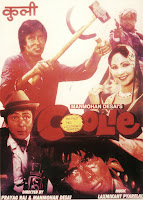


In past interviews, Bachchan's wife Jaya Bhadhuri, a celebrated actress herself, said she "doesn't believe in my husband's kind of cinema" and is a staunch critic of his films.

Within the Indian film industry, few criticise Bachchan. But in a rare interview a few years ago, legendary Lata Mangeshkar, the most successful singer in the history of Indian cinema, found fault with some of his films from the late 1980s. When I ask Bachchan about this, he says, "It is her opinion and I respect it, she's entitled to it."

Throughout the interview, Bachchan gives fluid and erudite answers, except when I ask him questions about the critics who've taken potshots at him. Then, and I can hear it (when I play back the tape!); he is less articulate and sounds a bit defensive. "It is their prerogative," he said at one point. "They should be given the freedom to express it and we, as actors, accept what they say."

Knowing the answer, I ask, has he ever had a problem with the Indian media?

"I don't think I've had a problem with them. Well... there was a problem, several years ago but that was amicably sorted out."

Some stars occasionally stop talking to the press, I point out, knowing he would know I was referring to his one time prohibition of press interviews. ALL press interviews. He created the first media ban in India - which did nothing to cease his marvelous cinematic career.

"Yes, I was under that [stars who ban the press] bracket... but that episode is over."


Bachchan is soaked in sweat and blood, clad in torn pants, a disheveled shirt and a red bandanna. When he comes onto the screen, the crowd roars, claps and whistles. You haven't witnessed Indian cinema, until you've seen a Bachchan film at a theatre filled with voluble fans.


This was in Southern India, in 1993, while I was attending my first movie ever with an all Indian audience, on Indian ground. The crowd claps at his dialogues and one-liners, some throw coins and lemons at the screen; like they do at the temples in Chennai, showing their reverence for the Gods.

During a song sequence, some dance in the aisles, others on their chairs. Suddenly, some break free and run towards the platform below the screen, to dance on stage. The show is halted. The police come, shuffle the over-enthusiastic fanatics away from the white screen. Calm is restored and the movie continues. I sit agape. You sense the power of this uncommon man with the common man.

He is no less than God for many ardent fanatics. He has his own temple in Calcutta, where devotees worship his photographs and a life-size sculpture. Attempts to buy his wax-replica from Madam Tussaud's in London were aborted (exorbitant costs of buying and shipping). But at the temple, fans can still hear the dialogues and songs from his films that continuously play on speakers. Naturally, his photographs, films, audio tapes, books, magazines and posters are on sale nearby.

He tells me the idol worship makes him a little uncomfortable ("It's highly embarrassing and I am humbled by my fans"). But the string of awards he's received in recent years is an annual tradition he's quite comfortable with, I think to myself. I'm corrected yet again.

"It means a lot to get this recognition," he says. "I don't crave it. I don't think I deserve it, but if it's given with good intentions, I welcome it and humbly accept it."

His own clothes are different. Impeccable, designer-labelled, even his accessories are stamped with an international logo. The eyes have a tinge of grey, his goatee is white and while his hair is jet-black, the cheeks sag a little. Alas, the man is mortal. This time, I see him at a press conference with his family. There is another Bachchan on the horizon of Indian cinema, trying to make it under his father's gargantuan shadow. The set phrase, "Nothing grows under the shadow of a Banyan tree," comes to mind from author R.K.Narayan.

Abhishek, Amitabh Bachchan's only son is trying to get a foothold in the film industry whilst Amitabh now cuts a fine father figure in the select films that he does. Four thousand miles away he may be, but even I can hear paternal pride on the phone, when I ask him about his son and the new generation of stars.

"I like all of them, they are all very talented and they're very well equipped, certainly more equipped than I was when I started. They have a huge sense of competition, a great passion to succeed and I think they work with heavier odds than we did at our time because they have to face an audience which is less tolerant. People have been tolerating me for a long time! But they have to be absolutely bang on at their first attempt," he says.

Before winding up what turned out to be 45 minutes and 36 seconds of talking with India's biggest star, I wonder if he had ever considered any other profession? "No I haven't. I'm just about managing this one!"

As the echolocation of his rich laugh fades, he continues. "I guess there are several roles that an actor wants to do but it's difficult to say offhand what they would be. If you get satisfied creatively, then that's the end of your life as an artist."

KEE Magazine, Summer 2006

* Kee would like to extend its gratitude to Mrs. Mira Mahtani and Ms Rosy Singh for arranging the interview.
* Images courtesy of Dharma Productions, B.R. Films

Monday, 5 April 2010

Savoir Faire: Michael Wong: Interview with Hong Kong Star: Cover story for High Life: Cigar Magazine

Hong Kong actor Michael Wong was in conversation with P.Ramakrishnan while he was blowing smoke up... at the Cigar Divan in Central. 

Images by ace photographer William Furniss.


According to Will Smith’s chart buster “Getting Jiggy With It”, the cigar is “for the look” but he doesn’t light it. For Hong Kong actor, model, producer and writer, Michael Wong, the cigar is all about the taste, the flavour, the mood and so much more.

As we meet for an interview at the Red Chamber Cigar Divan, which is adjacent to the iconic Shanghai Tang flagship store in Central, Wong settles himself into a lounge chair and lights up one of his favourites. “I love a good cigar and I’m so grateful that David Tang has this place set up for us aficionados,” he says. “A great cigar does cover the full range of emotion, it’s always there for you at the right time. It;s that great companion that’s there when you’re in a contemplative mood, if you’re ecstatically happy… whenever.”

Before we continue, let me narrate you this cigar and David related tale,” he says with a laugh. “I owe him! I had asked him a favour a few years ago, when I was doing a series with Dennis Hopper. I wanted to give Dennis a gift on behalf of the cast and crew and so I called David because I knew Dennis loved his cigars. David generously gave me a box of Sir Winston and Trinidad, but unfortunately, the timing didn’t work out. By the time I got back to location in Shanghai, Dennis had already left and I had to share the cigars with the crew!”

So you feel guilty about that?

“No, not even that. What I felt really guilty about was that I called David on the phone, and I was in a taxi back here in Hong Kong and he must have been in the London. I was in a really giddy mood, and I must have woken him up. I was yelling, “Wei, wei, wei!” And I was laughing because I was in the car with friends and joking around and finally I heard him say, “I can hear you, who is it?!” and I hung up! I was so embarrassed! PS: Dear David, that was me on the phone that time and I owe you an apology, and my extreme gratitude in accommodating me.”

Even the people watching the photo-shoot join in the laughter.

American born, 6-foot tall, Hong Kong movie star Michael Wong has acted in over 60 films in the last 23 years. Li Cheng (also known as Miles Apart) was the first film he directed and co-produced, while he has also modeled for international brands and appeared on television shows. Married to the glamourous model Janet Ma, and brother of fellow actor/model Russell, Wong’s high-profile career so far has been a wild concoction of hits and misses.


Reflecting back, he says, “I think it was in a movie I was working on in 1995 when I first had a cigar on film. The projection of the mafia or bad guys smoking didn’t really bother me. When I played the role, I was the good guy in the film who was smoking. I convinced the director that it should be a trait in the character. I was lucky that he agreed with me so it was a great excuse to smoke during the day - as part of the job.”

Wong insists that he never smokes in front of his children and if there are kids around, he doesn’t like it when people light up either. “Places like this divan, or a cigar chamber, I think men should be gentlemanly about smoking cigars, be in company that permits, no, company that enjoys it as much s you do. All good cigar smokers are gentlemen first.”


Red Chamber Cigar Divan
Shop M1, Mezzanine Floor
Pedder Building, 12 Pedder Street
Central
Tel: (852) 2537 0977


Cover story, The High Life

Saturday, 3 April 2010

Sartori-ally Savvy: Interview with Zegna's Alessandro Sartori: A Hong Kong Exclusive

Alessandro Sartori has made a mark under the Zegna label with incredible alacrity and proficiency. In less than a decade of joining the company, he has been planted as the creative head of the Z Zegna line. For P.Ramakrishnan, he lists the do’s and don’ts for the man who wants to be in GQ. Why not take note from someone who’s been there, done that?!


As members of the press and photographers teem at the Conrad, awaiting the man of the moment, Alessandro Sartori, subject of much interest as Zegna presents its latest line in Hong Kong, few note the large sign with the label’s emblematic logo hanging at the far end of the VIP room. With the usual clutch of company representatives and marketing heads. Sartori swiftly walks in, greeting all ebulliently.

Before he sits for the recorders, he, and only he, notices that the sign is slightly off kilter. Instead of snapping his fingers at his coterie of assistants to fix the aberration, he rushes forward himself, sets it right, and sits down, apologising profusely for the delay. Therein lies what separates him from a phalanx of others, that quest for perfection, that strive to make things just so, noting the devil in the details. This talent has served him well for within a short period of arrival at Zegna, he has escalated from the lofty title ‘Assistant to the Product Manager for Zegna Sartorial line', as his CV states, to the exalted position of Creative Director, Z Zegna, as his embossed calling card reads.

Z Zegna is the, if you will, “younger line” of the high-end menswear from Ermenegildo Zegna and just last year, Sartori was the recipient of the “Best International designer of the year” awarded by GQ Spain.

Over espressos, the conversation meanders about, he flinches when the overused and trite expression ‘metrosexual’ creeps into the dialogue. “I think the phrase metrosexual is over and neandersexual is in,” he says, and then corrects himself. “Well, its not in right now either. Is there a word for it… no. I think men are looking for something new, but they are always a little concerned about looking good, stylish. Easy elegance is what they really want. So now in fashion houses, there’s a focus on research done on fabrics, and quality and treatment. Mixing unusual elements together – metallic with linen, so a material looks soft and strong.”

Returning to the earlier phrase, he simply says, “I don’t like the term metrosexual at all. What does it really say anyway?”

What indeed!

In the age of men’s manicures and facials – and there’s nothing wrong with that - it’s the easy labeling and coinage of trivial expressions that Sartori can live without. So who’s metro… well, really well presented?

“You know, I think in today’s time it’s Jude Law that’s really stylish. Even after the scandals this year (referring to the infamous tryst with the nanny that’s been tabloid fodder!), I think the news of the affair makes him more human and not so fake and puritanical!”

“Among women, Nicole Kidman – which may seem like a cliché answer, but she really is so naturally stylish. And then there’s Monica Bellucci who is, of course, so very beautiful, her face is superb, super beautiful. Like a modern Sophia Loren,” he says. Stretching back into the lounge he continues. “But in film, there was no one like Marcello Mastroianni. Everyone refers to La Dolce Vita, not only because the movie was great, but the style in it. For me, the 1950s was a great period for fashion, not the ‘60s because by then I think it was too much. The decade before was when it was still refined.”

Under the aegis of Zegna – including all the lines under that umbrella – none of it be labeled as ‘too much’, the subtle sophistication is synonymous with the brand. Unlike the flash of his contemporaries where perhaps flamboyance has eclipsed elegance, the brand’s adherence to classic good looks is legendary.

So what’s a fashion ‘no no’ at the moment? “White socks with anything and everything! It should only be used in sports. Really. Worse than that is white ankle socks! In my wardrobe, the staples at the moment are blazers and jackets. I have many. I need something on top of my t-shirt or shirt, so I always wear a jacket. Jacket pockets are very smart now, man bags are a little over so a good jacket that will hold all your things is great; your phone, your wallet, your keys. Also, I think all men should invest in good leather items like belts and shoes. Something that will last.”

Three male models saunter in, as blinding flashes form the crop of photographers erupts. From where we’re seated, we’re at eye level with the shoes strutting along the makeshift stage. As I’m seated next to the designer, Sartori leans over and says, “You know the most expensive fashion item that I own is a pair of boots. I have this pair of horse hair boots, black ones. I don’t wear them anymore because they’re over-used, but I wore them nearly all the time for three years. I remember at the time I bought them, they cost me a quarter of my entire paycheck!”

Is it a complete fashion faux pas to wear sneakers? “No, I like trainers and sneakers, coloured ones, green, red, blue… but only during the holidays or my time off. Actually, even in my casual time, I wear simple leather shoes. Things you can slip on and off easily.”

It goes without saying that his favourite shoe designs are from the Zegna line. Which a laugh, he states, “Zegna does a great line of course, but even when I was an independent fashion consultant, in Hong Kong, many years ago, in the early ‘90s, I liked Zegna for its quality. Actually, my favourite shoe designer at the moment is a woman’s designer, Manolo Blahnik.”

We go through a volley of questions and while most upper tiers of international companies give well-rehearsed answers, Sartori is blissfully straightforward and real. For example;

Cuffs or button-hole?
“Cuffs, I think it’s a very simple thing to do to really smarten up your entire look.”

Most cherished fashion item?
“I have a leather blazer with a super soft touch. I’m not just saying this to advertise the Zegna line but I really do own a lot of it. When I design, of course I am making something that I would want to wear.”

High-end or high-street?
“A mixture of both, I think you can buy a really nice, well made pant but wear a very inexpensive t-shirt with it. With your own style, you can personalise more. You know when you see those people, with a head–to-toe look, out of a magazine, they are copying exactly what’s on a mannequin or in a magazine page. There's nothing unique about that – you must own your own look.”

Fashion disaster?
“The ‘80s! When you look back at the big hair and te huge shoulder pads! I really think that its is a trend that will never come back. At least I hope it won’t!”

Who would design your Oscar suit?
“When Adrian Brody won the Oscar, he was wearing Zegna. Sean Penn, Al Pacino, they’ve all worn Zegna when they won! So of course, I would too!”

Of course.


FLIGHT OF FANCY

Photography: William Furniss
Graphics and illustration: Hyvis Tong
Art Direction & Styling: Ann Tsang
Wardrobe & Accessories: Z Zegna and Ermenegildo Zegna
Model; Nacho C at Model Genesis


Earlier feature on Zegna's musical muse; Easy on the Ears